Article Details

Case Report
Volume 02, Issue 01 (January-March 2026)

Urgent Carotid Angioplasty via the Ulnar Artery in Bovine Arch Anatomy: A Case Report

Gabriele Venturi (MD)1*, Luca Bonizzi (MD)1-2, Mattia Zanoni (MD)3, Alberto Zamboni (MD)1, Alessandra Danese (MD)3, Michelangelo Turazzini (MD)3, Ugo Navarro (MD)4, Giorgio Morando (MD)1 and Antonio Mugnolo (MD)1

1Division of Cardiology, Mater Salutis Hospital, ULSS 9 Scaligera, Legnago (VR), Italy
2Division of Cardiology, Department of Medicine, University of Verona, Verona, Italy
3Division of Neurology, Mater Salutis Hospital, ULSS 9 Scaligera, Legnago (VR), Italy
4Division of Radiology, Mater Salutis Hospital, ULSS 9 Scaligera, Legnago (VR), Italy

*Corresponding author: Gabriele Venturi, MD, Division of Cardiology, Mater Salutis Hospital - ULSS 9 Scaligera, Via Gianella 1, 37045 Legnago (VR), Italy.
E-mail: gabriele.venturi.vr@gmail.com.

Received: 10 February 2026; Revised: 05 March 2026; Accepted: 08 March 2026; Published: 04 April 2026

Citation: Venturi G, Bonizzi L, Zanoni M, et al. Urgent Carotid Angioplasty via the Ulnar Artery in Bovine Arch Anatomy: A Case Report. Case Rep Case Ser Cardiol J. January-March 2026; 02(01): 25-29. DOI: doi.org/10.64874/crcscj.v2i1.2026.022.
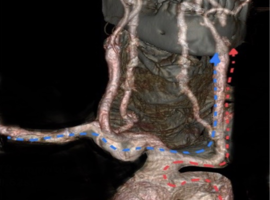
Article Image
Abstract

Background: Unusual aortic arch variants such as the bovine arch configuration can complicate carotid revascularization, often limiting the effectiveness of standard femoral access. Radial access is an established alternative, but data on ulnar access in neurovascular interventions remain scarce. We report a case of urgent left internal carotid artery angioplasty successfully performed via the ulnar artery after failed radial and femoral attempts, highlighting the feasibility of this approach in challenging anatomy.
Case Presentation: A 63-year-old man initially presented with suspected right-sided hemiparesis, with a normal supra-aortic Doppler ultrasound. One month later, he was readmitted for headache; brain CT revealed a right frontal hemorrhagic lesion, and CT angiography showed left internal carotid sub-occlusion due to a soft plaque, critical right internal carotid stenosis, and a type 2 bovine aortic arch. Due to hostile neck anatomy and high carotid bifurcation, percutaneous endovascular treatment was chosen over surgery. Initial radial access was not feasible, and femoral access provided inadequate support. Ulnar access was therefore obtained, enabling favorable navigation and deep catheter engagement. A dual-layer micromesh stent was deployed with distal filter protection, achieving successful revascularization and preserved hand perfusion. The patient showed neurological recovery during follow-up.
Conclusions: This case illustrates the ulnar artery as a safe and effective alternative vascular access for carotid angioplasty when both radial and femoral approaches fail, even in the absence of a palpable radial pulse. It emphasizes the potential of ulnar access to expand treatment options in complex arch anatomies and supports its consideration in selected urgent neurovascular interventions.

Keywords: Carotid angioplasty; Bovine arch anatomy; Ulnar artery access; Carotid stenosis; Stroke; Endovascular intervention