Article Details

Case Series
Volume 02, Issue 01 (January-March 2026)

Diagnostics of Significant Coronary Artery Stenosis in Asymptomatic Patients Based on Transthoracic Echocardiography Data

Ekaterina Guskova1*, Elena Kalinina1 and Angela Zagatina1-2

1Cardiology Department, Cardiocenter “Medika”, St. Petersburg, Russian Federation
2Cardiology Department, Saint Petersburg State University Hospital, St. Petersburg, Russian Federation

*Corresponding author: Ekaterina Guskova, Cardiology Department, Cardiocenter “Medika,”, Petrozavodskaya St., b.13, St. Petersburg  197110, Russian Federation.
E-mail: catherineguskova@yandex.ru.

Received: 03 March 2026; Revised: 05 April 2026; Accepted: 09 April 2026; Published: 10 April 2026

Citation: Guskova E, Kalinina E, Zagatina A. Diagnostics of Significant Coronary Artery Stenosis in Asymptomatic Patients Based on Transthoracic Echocardiography Data. Case Rep Case Ser Cardiol J. January-March 2026; 02(01): 30-35. DOI: doi.org/10.64874/crcscj.v2i1.2026.023.
Article Image
Abstract

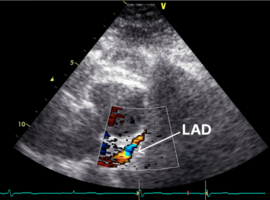
Background: Up to 50% of patients with myocardial ischemia may remain asymptomatic until the occurrence of an acute coronary event. Identification of high-risk individuals without clinical manifestations remains a diagnostic challenge. Assessment of coronary artery flow during routine transthoracic echocardiography may provide additional information in patients with silent ischemia. Coronary artery ultrasound is rarely used in routine clinical practice, primarily due to technical challenges, operator dependency, and the availability of more established imaging modalities like CT angiography and invasive coronary angiography, although coronary ultrasound is non-invasive and free of radiation, making it much more patient-friendly and potentially advantageous. However, the following cases will highlight situations where coronary ultrasound provides crucial, timely insights that can influence diagnosis and management, demonstrating its potential value beyond standard use.
Case Presentation: We present a series of three asymptomatic male patients aged 37-44 years with cardiovascular risk factors who underwent transthoracic echocardiography with coronary artery flow assessment. None of the patients reported chest pain, dyspnea, or exercise intolerance, and no ischemic electrocardiographic changes were observed during stress testing. Coronary artery screening revealed persistently increased diastolic flow velocities in the proximal segments of the left anterior descending artery. Subsequent stress echocardiography demonstrated extensive inducible ischemia in all cases. Coronary angiography confirmed significant coronary artery stenoses, predominantly affecting the proximal and mid segments of the left anterior descending artery. All patients underwent effective surgical treatment.
Conclusion: Determination of coronary flow velocity during routine transthoracic echocardiography may serve as a valuable adjunctive diagnostic instrument for finding substantial coronary artery disease in asymptomatic patients with cardiovascular risk factors.

Keywords: Silent ischemia; Coronary artery disease; Coronary flow velocity; Stress echocardiography; Transthoracic echo coronary Doppler