Article Details

Case Report
Volume 02, Issue 02 (April–June 2026)

Case Report of a Totally Occlused Abdominal Aortic Aneurysm

Hakan Ercan, Sergen Bağdad, Hasan Altun, Mustafa Polat and Ali Karakuş*

Department of Emergency Medicine, Faculty of Medicine, Hatay Mustafa Kemal University, Hatay, Turkey

*Corresponding author: Prof. Dr. Ali Karakuş, Department of Emergency Medicine, Faculty of Medicine, Hatay Mustafa Kemal University, Hatay, Turkey.
E-mail: drkarakus@yahoo.com.

Received: 26 April 2026; Revised: 14 June 2026; Accepted: 29 June 2026; Published: 07 July 2026

Citation: Ercan H, Bağdad S, Altun H, et al. Case Report of a Totally Occlused Abdominal Aortic Aneurysm. Case Rep Case Ser Cardiol J. April-June 2026; 02(02): 45-49. DOI: doi.org/10.64874/crcscj.v2i2.2026.026.
Article Image
Abstract

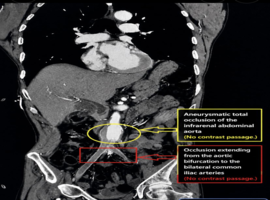
Aortoiliac occlusive disease is a severe form of peripheral artery disease resulting from progressive atherosclerotic narrowing or occlusion of the abdominal aorta and iliac arteries. Total abdominal aortic occlusion is a rare but life-threatening vascular pathology representing the advanced stage of Leriche syndrome. Leriche syndrome (aortoiliac occlusion syndrome) develops as a result of chronic obstruction at the abdominal aortic bifurcation or in the iliac arteries. Due to complete occlusion of the abdominal aorta, symptoms include absence of femoral pulses, inability to walk (severe claudication), pain even at rest, impotence, and severe ischemic pain and coldness in the lower extremities. It often develops due to progressive atherosclerotic disease or a thrombus within an aneurysm. Especially when associated with an abdominal aortic aneurysm, the risk of acute or subacute limb ischemia, amputation, and mortality increases significantly. Computed tomography (CT) angiography is currently recognized as the gold standard imaging method for both confirming the diagnosis and assessing the anatomical extent of the lesion. Early diagnosis and the determination of an appropriate revascularization strategy are of critical importance in reducing limb loss and mortality. In this case presentation, a case of total aortoiliac occlusion due to a thrombosed abdominal aortic aneurysm in a patient who had previously undergone an aortobifemoral bypass operation is presented, and the diagnostic approach and treatment process are discussed in light of the current literature.

Keywords: Leriche syndrome; Aortobifemoral bypass; Abdominal aortic aneurysm; İschemic pain; Computed tomography angiography