Article Details

Clinical Image
Volume 02, Issue 01 (January-March 2026)

A Rare Cause of Chest Pain and Pericardial Effusion

Abdullah Muhammad Nasser1* and Makram Ebeid2

1Undergraduate Studies, Department of Biology, University of Toledo, Toledo, Ohio, USA
2Professor, Division of Pediatric Cardiology, The Children’s Heart Center Children’s of Mississippi, University of Mississippi Medical Center, 2500 North State Street, Jackson, USA

*Corresponding author: Abdullah Muhammad Nasser, Undergraduate Studies, Department of Biology, University of Toledo, Toledo, Ohio, USA.
E-mail: Abdullahmnasser23@gmail.com.

Received: 25 January 2026; Revised: 08 February 2026; Accepted: 09 February 2026; Published: 26 February 2026

Citation: Nasser AM, Ebeid M. A Rare Cause of Chest Pain and Pericardial Effusion. Case Rep Case Ser Cardiol J. January-March 2026; 02(01): 15-17.
DOI: doi.org/10.64874/crcscj.v2i1.2026.020.
Article Image
Abstract

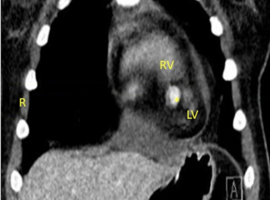
A teenager with a history of pectus excavatum presented with acute-on-chronic chest pain.  Two years prior she had a normal cardiac echocardiogram and normal pulmonary function tests. Although described as sharp and intermittent, the pain worsened in severity from 3 to 8/10 over the past two weeks. The pain is worse with activity and movement. Clinical workup included an electrocardiogram that was reassuring and an echocardiogram that showed mild to moderate pericardial effusion.  A cardiac CT was done that showed a 12 mm ventricular pseudoaneurysm arising from the lateral anterior wall of the right ventricle. Figure 1 and 2. A cardiac MRI confirmed the diagnosis. Given that the idiopathic pseudoaneurysm as the etiology for the effusion, she elected to go to the catheterization laboratory for closure. The pseudoaneuysm was entered with 6fr 3drc catheter via right femoral vein and a 6-4 Amplatzer ductal occluder type 2, (ADO2) device was placed. A right ventricular injection confirmed successful occlusion. Figure 4.  In follow up her pericardial effusion has minimized and she has been maintained on a low-dose aspirin aspirin. Although left ventricle aneurysms and pseudoaneurysm can be seen in adults, idiopathic right ventricular pseudoaneurysm, especially in children is very rare [1].